


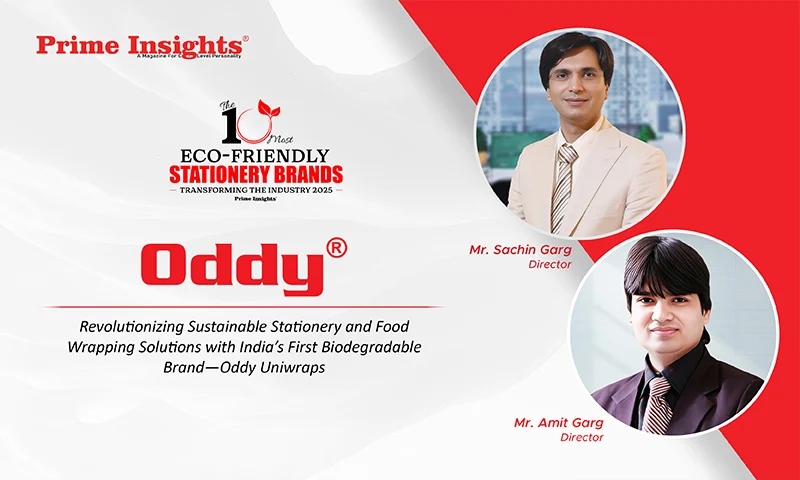
Oddy
Did you know that producing a single A4 sheet of paper can require around 5 liters of water? The stationery industry, far from being simply about pens and paper, is at the top of a quiet, impactful revolution for sustainability.
Leading this is Atul Paper Pvt. Ltd. and its flagship brand Oddy, founded in 1999. CEO Mr. Atul Garg initially focused on ‘on-demand’ quality. His entrepreneurial shift began after observing aluminum foil’s adverse food reaction, inspiring R&D. This led to the 2017 launch of ODDY Uniwraps—India’s first certified food-safe, biodegradable wrapping paper. This experience cemented sustainability as a core standard across Oddy’s diverse stationery and office supply range.
Oddy integrates ‘eco-friendliness’ throughout its process. They prioritize closed-loop manufacturing, using recycled/reused materials to minimize waste. Their stationery features safe materials like acid-free glues and recycled paper. Uniwraps, made from patented virgin cellulose, are chlorine-free and reheatable, with in-house manufacturing making sure of traceability. They maintain a sustainable supply chain via vetted vendors and an efficient pan-India distribution network.
In the spotlight is founder Mr. Atul Garg, CEO, in an exclusive interview for our prestigious “The 10 Most Eco-Friendly Stationery Brands Transforming the Industry 2025” edition. Learn from his insights and valuable lessons as an entrepreneur to excel and make it the best company. Stay tuned and learn his tale of success!
Prime Insights: Let’s start with a quick overview of your brand and its core stationery offerings. What makes your brand unique in the eco-friendly segment?
We founded Oddy, the flagship brand of Atul Paper Pvt. Ltd., in 1999, offering over 1200 stationery and office supply products used daily by millions across India. Our eco-friendly range includes biodegradable envelopes, acid-free glue sticks, recyclable sticky notes, and non-toxic chemical-based items. Apart from these, our core stationery offerings also include masking tapes, die-cut labels, ST labels, laser labels, foam tapes, wall-covering media, etc.
Taking advantage of our expertise in paper, we established UIPL Innovations Pvt. Ltd. (ODDY Uniwraps) in 2017—a step towards revolutionizing the food packaging industry—offering Oddy Uniwraps: a biodegradable, non-toxic, and safer alternative to conventional materials like aluminum foil, cling film, butter paper, etc.
At Oddy, we don’t treat sustainability as a trend; it’s built into how we think, make and serve.
Prime Insights: What inspired the foundation of your brand, especially with a focus on sustainable stationery products?
Our brand, Oddy (OD: On Demand), was founded on a simple philosophy: best quality, on time, on demand, at reasonable prices. After gaining traction, Mr. Atul Garg noticed a need for safer, eco-friendly options, so we introduced acid-free, non-toxic adhesives; biodegradable envelopes; eco-friendly wallpapers; and recyclable copier paper.
His sustainable mindset for the company solidified after observing aluminum foil reacting badly with pickles at a picnic. This inspired months of R&D, leading to ODDY Uniwraps, India’s first certified food-safe, biodegradable wrapping paper. Now, sustainability is our brand’s baseline standard.
Prime Insights: How do you define eco-friendliness, detailing your sustainable production practices and materials?
For me, eco-friendliness isn’t just a label; it’s fundamental to how we procure, produce, and deliver. I prioritize “closed-loop manufacturing,” constantly using recycled and reused materials to reduce waste and raw material needs. We choose safe materials for both people and the planet, like our acid-free, non-toxic glues and washable, solvent-free correction pens. Recycled paper forms the core of many products, and our eco-friendly envelopes use compostable Kraft paper. Our flagship, Uniwraps, uses a patented, chlorine-free cellulose base, manufactured in-house for traceability and hygiene. We also make sure of sustainable distribution via our pan-India depot network.
Prime Insights: What were some of the initial challenges you faced while shifting to or starting with an eco-conscious approach in the stationery sector?
As a manufacturer, we have faced some challenges while starting an eco-conscious approach in our process.
- Sourcing sustainable raw materials: We have faced challenges in finding reliable suppliers for eco-friendly materials.
- Higher Production Cost: Eco-friendly materials and processes often cost more, which results in higher production prices and thinner profit margins.
- Market acceptance & consumer awareness: Customers may not understand the benefits of eco-friendly production or might be hesitant to pay a premium.
Prime Insights: Can you tell us about any certifications, partnerships, or recognitions your brand has received for its sustainability initiatives?
We’re proud to have received the National Startup Award 2021 from the Government of India for our innovation and environmental impact through Oddy Uniwraps. As a brand, we strictly adhere to FSSAI and FDA food safety standards and are certified biodegradable—Uniwraps decomposes within 90 days under composting conditions. Our ISO-certified in-house manufacturing ensures both quality and eco-responsibility. We’ve partnered with LT Foods to scale sustainable products across India through an established supply chain. Oddy Uniwraps has earned the Amazon Best Seller tag and boasts a brand recall index of 2100, far exceeding category norms. Schools and institutions have adopted Uniwraps as a replacement for aluminium foil in lunch policies. Our products are retailed across D-Mart, Reliance, Metro, Tesco, and 2500+ general trade stores. We actively collaborate with platforms like AIESEC India to raise awareness. Additionally, our stationery products follow strict internal protocols—using acid-free, non-toxic, and recyclable materials across key SKUs.
Prime Insights: How do you balance affordability and environmental responsibility in your products for mass-market appeal?
I believe sustainability shouldn’t be a luxury. I’ve worked hard to make eco-friendly stationery and Oddy Uniwraps affordable. At INR 199 for a 20-meter roll, Uniwraps are priced like traditional aluminum foil but are fully biodegradable in just 90 days, unlike foil which takes over 400 years to decompose. They’re also food-safe, non-toxic, reheatable, freezer-friendly, and leak-resistant—designed specifically for Indian food. Every 1000 households switching saves 5.5 tons of carbon emissions, and with 3 lakh households already using Uniwraps, we’re seeing carbon cost savings of $125,000 in 2024 alone. Our planned impact by 2030 is an $830,000 annual saving with 20 lakh households.
Economically, Uniwraps contributes INR 75 per unit directly back into the Indian economy through employment in manufacturing, distribution, and retail, an impact that has already crossed INR 35.2 crore by March 2024.
Across our stationery range too, we maintain this balance. Our glue sticks are acid-free and non-toxic, yet priced for school and office budgets. Our eco-friendly brown envelopes, reusable folders, and numerous paper products are made from recyclable or biodegradable materials, remaining affordable through in-house manufacturing and wide distribution. Our approach ensures safe, responsible products are accessible to all, making sustainability and scale two sides of the same mission.
Prime Insights: In what ways do you engage customers and raise awareness about the importance of using eco-friendly stationery?
Traditional stationery often uses non-renewable resources and harmful chemicals. I aim to minimize this by using recycled or sustainably sourced materials, reducing waste, and carbon footprints. I engage customers through education, transparency, and community involvement. I share informative content, clearly label eco-friendly materials, and run campaigns rewarding sustainable choices. Collaborating with schools and influencers helps amplify our message, inspiring more environmentally responsible decisions daily.
Prime Insights: Have you launched any unique campaigns, school programs, or community outreach projects promoting sustainability through stationery?
Yes, to establish Oddy Uniwraps as a sustainable food-wrapping solution, we adopted a multi-tiered strategy. We leveraged LT Foods’ robust pan-India network to host “Uniwraps Launch” events in major cities like Delhi and Mumbai.
A key initiative was our partnership with AIESEC for “Food Safety and Sustainability” programs in Delhi-NCR schools. We educated students and distributed free samples, reaching parents directly. Many schools even replaced aluminum foil with Uniwraps and informed parents, leading to families switching at home.
For wider reach, we collaborated with health-conscious food and lifestyle influencers, amplifying our brand to over 30 million people and showcasing creative Uniwraps uses. We also launched an online Recipe Book featuring these collaborations. Furthermore, radio ads and exclusive interviews across regional stations boosted our sustainability message. We engaged directly with consumers through stalls in residential societies and in-store demonstrations, highlighting Uniwraps’ health benefits and lower carbon footprint.
Prime Insights: What are some customer favorites or flagship products that have become symbols of your sustainable brand identity?
Oddy Uniwraps has truly become a cornerstone of our sustainable brand identity. This innovative food paper biodegrades 100% within 90 days and is meticulously designed to be food-safe, non-toxic, and free from harmful chemicals.
Our first-mover advantage has led to strong brand recognition, with “Oddy Wrap” often used synonymously with food wrapping paper. This is reflected in our exceptional Amazon brand recall (2100 vs. competitor average 196) and a 78% repeat purchase rate, driven by patented quality and continuous SKU innovations like circles and snack bags. Our partnership with LT Foods ensures widespread availability without compromising pricing.
Oddy Uniwraps directly addresses the shortcomings of traditional options. Unlike aluminum foil or plastic wrap, it won’t contaminate food or melt in the microwave. It surpasses butter paper by being greaseproof, non-stick, and resistant to sogginess. Made from 100% pure wood pulp and food safety certified, it ensures food remains healthy. Its suitability for deep freezing and ability to stay intact for hours make it a true multi-purpose kitchen essential. Our aim is for this product, with its immense potential, to reach every Indian household.
Prime Insights: What is the role of the stationery industry in combating climate change and promoting sustainable living?
I strongly believe the stationery industry plays a vital role in combating climate change and promoting sustainable living. While often seen as low-impact, traditional production contributes significantly to deforestation, pollution, and landfill waste through its reliance on virgin resources, water-intensive processes, plastic packaging, and the use of chemical inks.
For me, this represents both a responsibility and a massive opportunity. I believe in leading by example through promoting conscious consumption with products made from recycled or plant-based materials. I’m committed to doing innovation in materials, adopting alternatives like seed paper and bamboo pulp, and reducing waste and focusing on carbon emissions with thoughtful design and plastic-free packaging. Even small items, when used at scale, create a huge impact. I see stationery as a powerful tool for educating through everyday use. It’s a touchpoint that can normalize sustainable living, especially for younger generations, sparking awareness and encouraging greener choices at work, school, and home. The industry must innovate not only in product design but also in how it communicates and collaborates to shape a much better future.
Prime Insights: What milestones or transformations has your brand seen in its sustainability journey so far?
Mr. Atul Garg has led Oddy to significant sustainability milestones and market transformations. He launched Uniwraps in 2017, making it a biodegradable, food-safe option. We then introduced Ecobake parchment paper for reusability. In November 2024, he expanded into the HoReCa sector with advanced, sustainable food specialty papers. All Oddy Uniwraps are 100% biodegradable, reflecting his deep commitment to eco-friendly practices. He has earned a name among chefs for quality and sustainability.
We did a nationwide shelf visibility campaign, securing prime retail space and complementing it with targeted social media. We also initiated a school awareness campaign on the health risks of aluminum foil, promoting Uniwraps and aligning with UN SDG 3. Additionally, we have leveraged digital marketing and influencer partnerships, reaching over 30 million people to enhance brand visibility and build trust. There have been continuous support from Mr. Amit Garg & Mr. Sachin Garg.
Prime Insights: What does the future look like for your brand—any new products, expansions, or innovations based on green technology?
Our future is all about weaving sustainability into the fabric of daily life in Indian homes, schools, and offices. For Oddy Uniwraps, our vision is to reach 20 lakh households by 2030. This isn’t just about sales; it’s about making a real impact, aiming to reduce over 9,700 tonnes of carbon emissions annually and achieve environmental savings of over INR 7 crore each year. We’re constantly expanding the Uniwraps range with new SKUs like snack bags, baking sheets, and pre-cut formats, all designed to curb plastic and foil use.
Beyond Uniwraps, we’re developing a reusable filtration paper for fast-food chains and local eateries. This addresses a critical public health issue: the unsafe reuse of cooking oil, which can lead to serious health problems. Our filters, like Uniwraps, are biodegradable, food-safe, and cost-effective, promoting healthier food preparation. In our stationery line, we’re dedicated to expanding our portfolio of biodegradable envelopes, non-toxic adhesives, and recyclable office supplies, alongside packaging innovations that cut waste. Ultimately, through in-house R&D and transparent sourcing, we aim to make Oddy the most accessible and trusted name in eco-friendly daily-use products across India.
Prime Insights: What message would you like to tell other emerging brands that want to be part of the sustainable revolution in the stationery world?
To all new brands getting into the stationery world: embrace sustainability not as a trend, but as a core value. From the materials you choose to the way you package and deliver your products, everything matters. Focus on building long-lasting, purposeful items that not only serve but also inspire. Be transparent, educate your customers, and always strive to do better. The future of stationery is not just beautiful—it’s responsible. Let’s build it together, one page at a time.